Complexity Disclosure Top Down Vibe Coding And Taking Notes
Hey, Luca here, welcome to a new edition of Refactoring! Every week you get:
Here are the latest editions you may have missed:
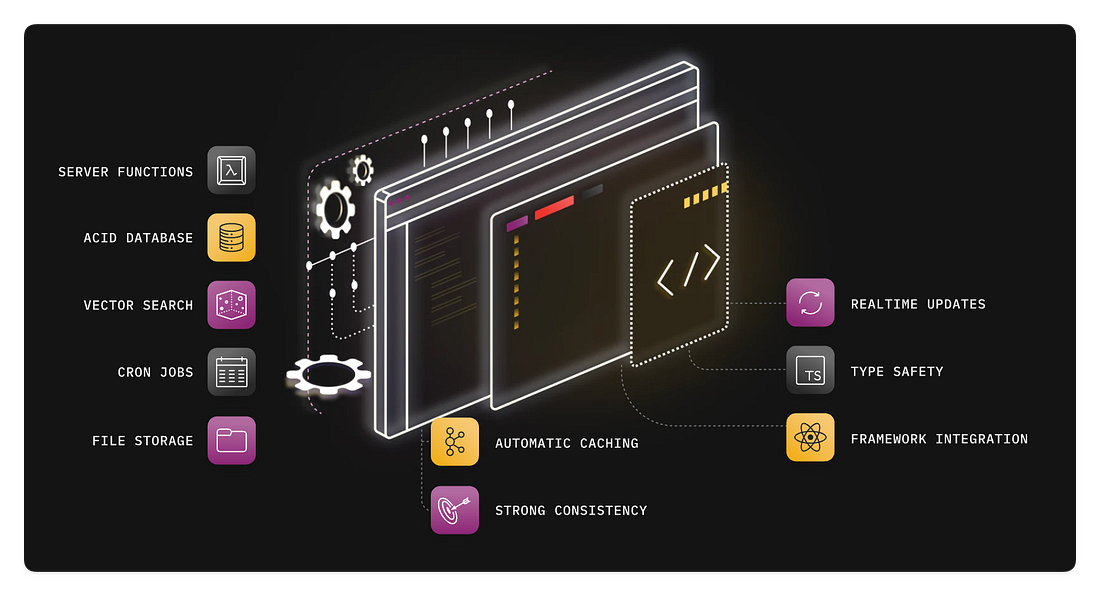
To access all our articles, library, and community, subscribe to the paid version: 1) 🔌 The backend platform for AIThis week I am happy to promote Convex, which I am a big fan of! Convex is an open-source database and backend platform where everything is expressed in Typescript: the DB schema, cron jobs, server functions, and more. This makes it perfect for LLMs, which can configure and create everything through code.
Also, Convex is reactive: its libraries guarantee that your app always reflects changes to your frontend / backend code and database state in real time. Never think about state management, cache invalidation, or websockets ever again. You can learn more below 👇 2) 🔬 Progressive disclosure of complexityA couple of months ago I interviewed Guillermo Rauch, CEO of Vercel on the podcast. We talked a lot about good design principles, and one of the ideas that stuck the most with me is what Guillermo calls "progressive disclosure of complexity" — creating technology that's approachable for beginners but eventually powerful enough for enterprise needs. This principle guides the design of Next.js, which starts with minimal code (as little as one line) but scales to power many of the internet's largest websites:
Guillermo said he draws inspiration from products like the iPhone, which can be used by both children and the elderly while still serving business professionals with complex needs. So, his approach to API design focuses on what he calls token minimization — requiring minimal code to get started, then gradually introducing more sophisticated features as needed:
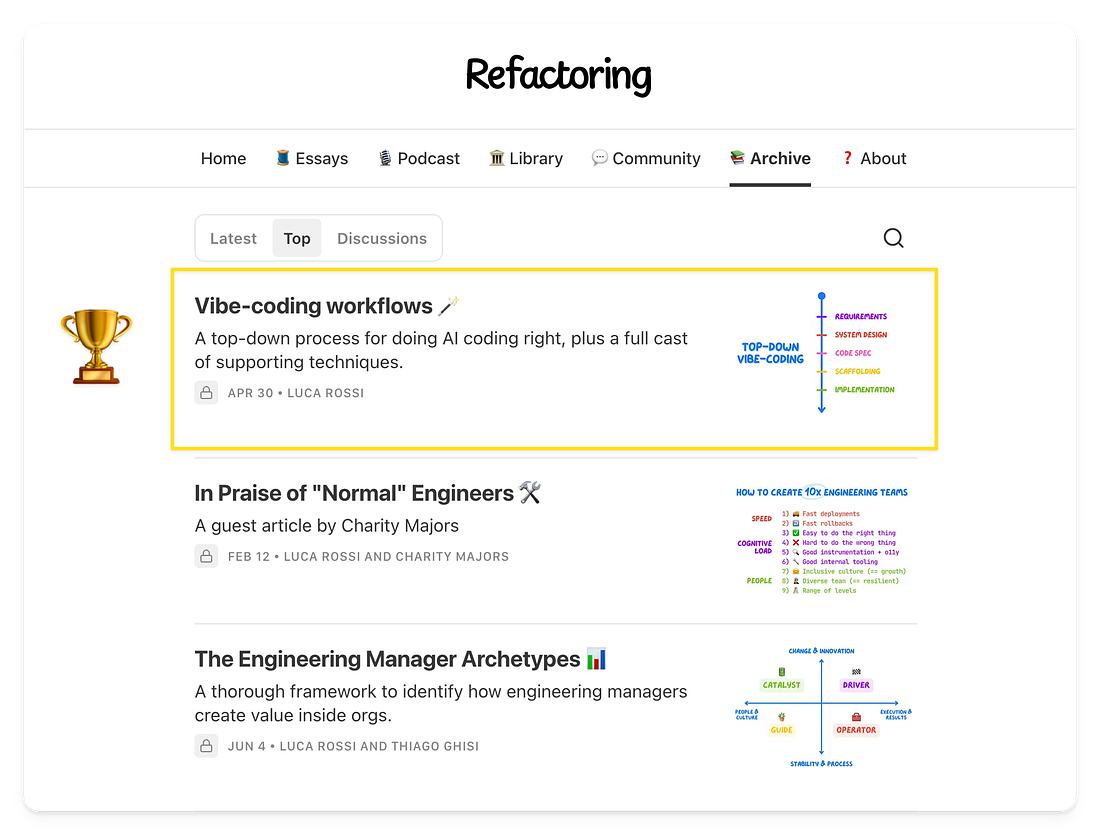
You can find the full interview below 👇 3) ⬇️ Top-down vibe codingIn April I wrote an article together with Justin Reock, deputy CTO at DX, about good vibe coding workflows, which is now the most popular Refactoring article ever! 👇
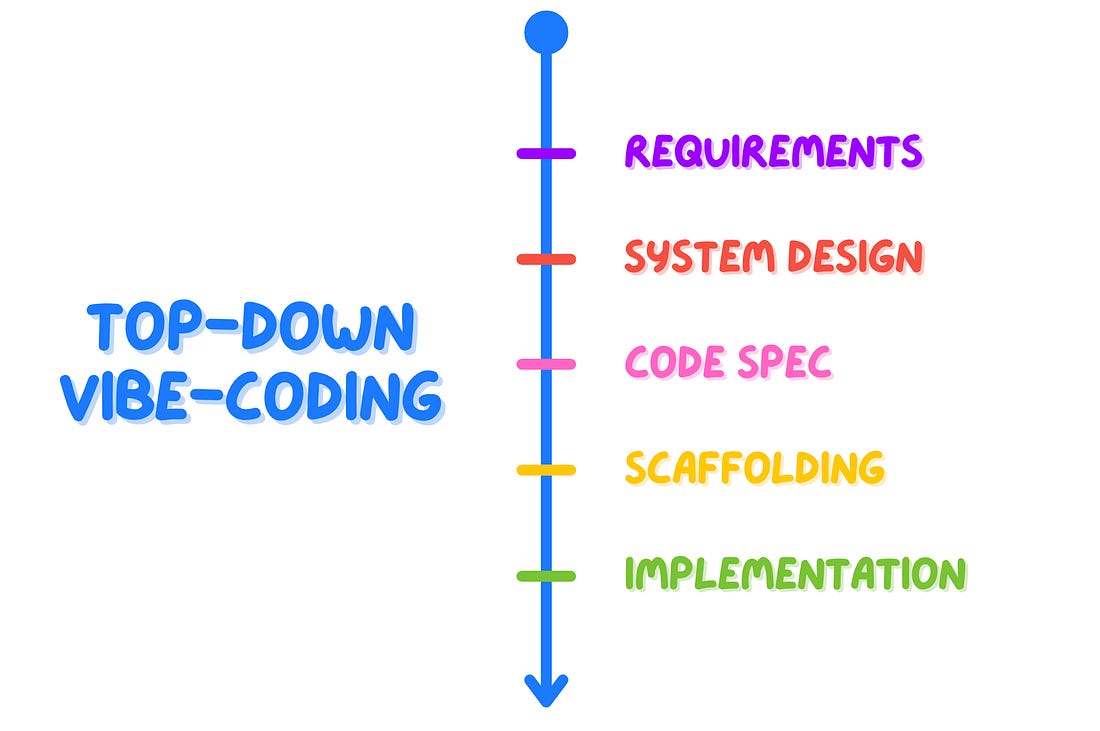
In the article we argue that the difference between a good and a bad output often lies in good prompting, and, even more, in your prompting workflow. For new developments, like new features or entire small projects, we have found that the most effective workflow is a top-down interaction that goes through several steps. You can begin with a discussion about your work requirements, and, step by step, get to high-level system design, the full code spec, classes and functions scaffolding, up to the fully coded version.
Working top-down is not only good for the AI output — it is also incredibly helpful in keeping the developer engaged in the work. It optimizes human cognitive load and allows to intercept errors at the right level. In fact, you don’t want to rectify system design elements, or worse, requirements misunderstandings, after the AI has written the full code, just like you don’t want it with humans. Still, many vibe-coding examples you can find online dive code-first into AI implementation, which is easily overwhelming for humans and more prone to errors. Let’s see how this works in a real-world example. For an initial requirements brainstorming, you can use a simple prompt like this: Example prompt
Example output
Also remember that voice prompting is faster than typing, and less cognitively intense! You can use that especially for the first steps. Once you’ve engaged in enough questions, the AI will let you know that you are moving into final questions, and may produce a summary similar to this:
Given a similar prompt to the one above, the assistant will then ask if you are ready to create a code spec based on these answers, and whether there are any final requirements. It will produce a spec similar to the following truncated example output:
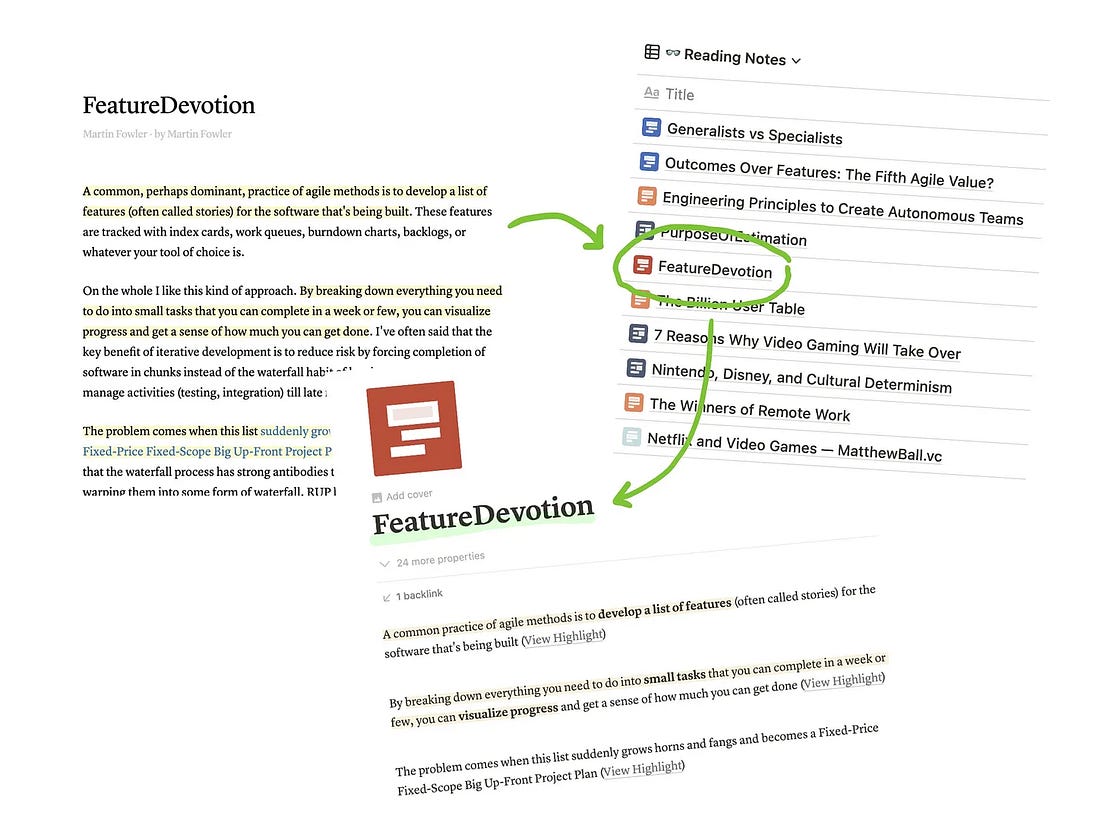
As powerful as this process is already at this stage, we can take this workflow even further by scaffolding code from this spec, and then using mid-loop code generation on that scaffolding to generate a draft of the application code itself. By working top-down it is easier for a developer to retain control over what is being produced, and correct mistakes at the right altitude. Design mishaps can get rectified before any code is generated, and structure corrections can happen when the code is still at the scaffolding stage. This is still vibe-coding, but it focuses on generating the right vibes. You can find more examples and ideas in the full article 👇  3) ✏️ How I take notes from readingsOne of the most recurring questions I receive is about my writing workflow — and especially about how I take notes and retain knowledge. I read nearly everything from my backlog, which I keep on the Readwise Reader (see the reading online article). For each article I highlight the most relevant passages, and these are sent to my Notion automatically by Readwise itself. Readwise creates a note for each article I have read and highlighted, and such notes only contain my highlights. This is all done automatically.
Once a week I review what I read the week before, link items to existing article ideas (not published yet), or create new ones specifically. At any given time, I have tens of open article ideas — 23 right now to be precise. These are just rough sketches, usually a few bullet points. They include notes from myself, references to readings, community threads, and more. Whenever I read something, I may think “this can be useful for this article” and link it there. I only start writing an article when I believe I have enough material to write a great piece. That means an idea can stay there for many months before I actually go and write a full article about it. Two years ago I wrote a full article about how I write and grow Refactoring, which I attach below. The newsletter is ~5x bigger now, but my process hasn’t changed a lot during this time — which looks like a good thing to me! And that’s it for today! If you are finding this newsletter valuable, consider doing any of these: 1) 🔒 Subscribe to the full version — if you aren’t already, consider becoming a paid subscriber. 1700+ engineers and managers have joined already! Learn more about the benefits of the paid plan here. 2) 📣 Advertise with us — we are always looking for great products that we can recommend to our readers. If you are interested in reaching an audience of tech executives, decision-makers, and engineers, you may want to advertise with us 👇 If you have any comments or feedback, just respond to this email! I wish you a great week! ☀️
|